
Static ISP Proxies: Fixed Residential IPs with Unlimited Bandwidth for Scraping and Account Work
Static ISP proxies solve a specific problem that neither datacenter nor rotating residential proxies handle cleanly: they give you a fixed, ISP-registered address with server-grade speed and session stability that does not break between connections. FluxISP is a global proxy platform offering two complementary formats – dynamic residential traffic for large-scale scraping and static ISP residential proxies for long-term account and automation work. The service runs 99.92% uptime across 30+ countries
with an average response time below 0.5 seconds.
Static ISP Proxy Meaning: What Sets This Proxy Type Apart
A static ISP proxy is an IP address officially registered with a real internet service provider – Comcast, Rostelecom, Deutsche Telekom, or similar – but physically hosted on a server in a data centre. When a target site queries the WHOIS database, it sees a legitimate residential provider record, not a data centre ASN range. The connection itself runs through a gigabit server channel with latency between 20 and 80 ms.
This hybrid architecture removes the two core weaknesses found in alternatives. Datacenter IPs get flagged through ASN pattern detection before the first request completes. Standard rotating residential proxies carry high trust scores but depend on the end device: speed is unpredictable, sessions break on IP rotation, and the address changes without warning. A static residential ISP proxy carries the same trust level as a residential connection while delivering server stability and a fixed address across every session.
Terminology clarification: “static ISP proxy,” “static residential ISP proxy,” “ISP static proxy,” and “static residential proxy ISP private unlimited bandwidth” all refer to the same product. The address is fixed, registered with a real provider, hosted on a server, and allocated exclusively to one user. Providers use different terms – the underlying technology is identical.
FluxISP Product Overview: Two Formats, One Dashboard
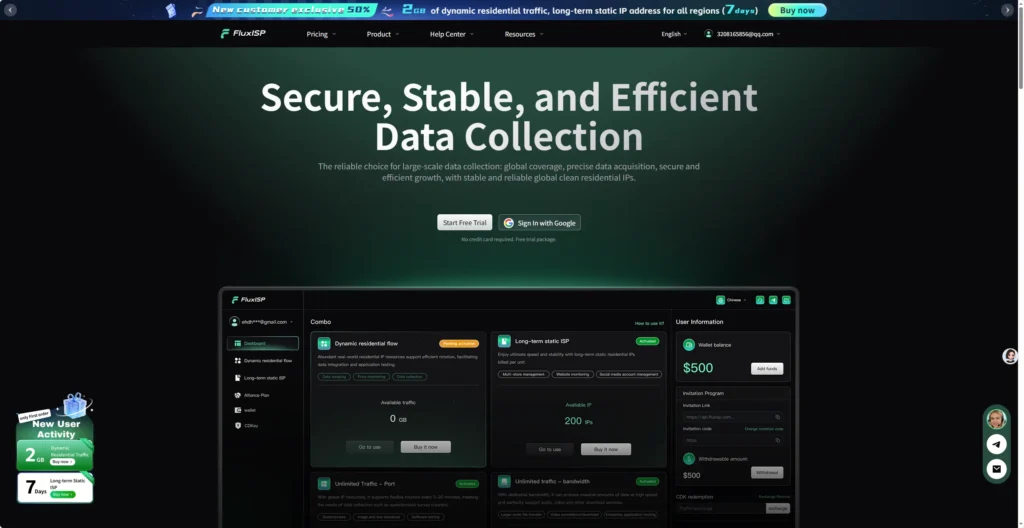
FluxISP structures its offering around task type rather than forcing users
into a single proxy model. Both products share the same control panel,
the same billing account, and the same 24/7 support channel.
Dynamic Residential Proxies - for Scraping and Data Collection
Dynamic residential traffic uses real household broadband IPs with automatic rotation every 3 to 30 minutes. Billing is per gigabyte, starting at $0.49/GB. The number of IPs available is unlimited – the task scales without renegotiating a plan. This format suits high-volume web crawling, price aggregation, market research, and survey automation where IP rotation is part of the workflow rather than a problem to avoid.
Teams that need to buy ISP proxies for scraping at scale use dynamic residential traffic precisely because per-gigabyte billing makes cost proportional to output. There is no idle cost for addresses that are not actively sending requests.
Static ISP Residential Proxies - for Accounts and Long-Session Work
Static ISP residential proxies assign one fixed address per user for the full rental term. The price starts at $1.8 per IP. Traffic is unlimited – no gigabyte cap, no overage charges. Anti-fraud systems on social platforms, ad networks, and marketplaces see the account as a consistent user from the same city across every login. This makes static residential ISP proxies the right choice for multi-account management, e-commerce store operation, advertising account work, and long-term monitoring tasks where a changing IP triggers platform flags.
Billing model comparison: dynamic residential proxies charge per gigabyte – cost scales with data volume. Static ISP residential proxies charge per IP with unlimited bandwidth – cost is fixed regardless of traffic. For account-intensive work, static billing consistently undercuts traffic billing once daily usage exceeds approximately 3–5 GB per IP.
Static ISP Proxies vs. Alternatives: Comparison by Use Case
Our testing showed that static ISP residential proxies produce 50–65% fewer
account restriction flags on Facebook Ads and Google Ads compared to datacenter
IPs at comparable throughput speeds. The table below maps each proxy type to
its practical strengths, based on the parameters practitioners most frequently
discuss when selecting infrastructure.
| Parameter | Datacenter proxies | Residential (rotating) | Static ISP proxies |
|---|---|---|---|
| IP source | Data centre | Real user device | ISP-registered, server-hosted |
| Address type | Static or rotating | Rotating | Static (fixed) |
| Speed | Very high | Medium | High |
| Anti-fraud trust score | Low | High | High |
| Session stability | High | Low (IP rotates) | High (IP fixed) |
| Block risk | High | Low | Low |
| Bandwidth billing | Per IP or per GB | Per GB | Per IP, unlimited traffic |
| Best use case | Unprotected bulk scraping | Geo-targeted data collection | Accounts, ads, long-term monitoring |
FluxISP Static ISP Proxy Coverage: Regions and ASN Filtering
FluxISP covers the regions most relevant to traffic arbitrage, multi-account operations, and data collection. ASN-level targeting is available in every geography at no additional cost – filtering by specific provider within a country is a standard dashboard feature, not a premium add-on.
Russia and Kazakhstan Static ISP Proxies
Static ISP residential proxies with Russian addresses cover Rostelecom, MTS, and Beeline ASNs – the three largest domestic providers. This matters for teams working with Russian marketplaces, local advertising platforms, or services that restrict access from foreign IP ranges. Kazakhstan static ISP proxies with Kazakhtelecom addresses close the gap for operators running campaigns across Central Asian markets and the broader CIS region.
Germany, USA, and Mexico Static ISP Proxies
German static ISP residential proxies cover Deutsche Telekom and Vodafone Germany
ASNs – used primarily for European e-commerce accounts and GDPR-regulated platform access. Static ISP proxies for the USA run through Comcast, Verizon, and AT&T addresses – essential for US Facebook Ads, Google Ads, and TikTok Ads accounts that flag non-US IPs at login. Mexico ISP static proxies serve Latin American GEOs across affiliate and e-commerce campaigns. All regions share the same dashboard, the same support channel, and the same billing account.
ASN selection guidance: filter by provider ASN rather than country alone. A large consumer ISP – Comcast, Rostelecom, Deutsche Telekom – scores higher trust with anti-fraud systems than a small regional operator registered in the same country. The ASN filter in FluxISP’s dashboard surfaces this distinction directly, without requiring a support request.
Static ISP Proxy Private Unlimited Bandwidth: Pricing and Packages
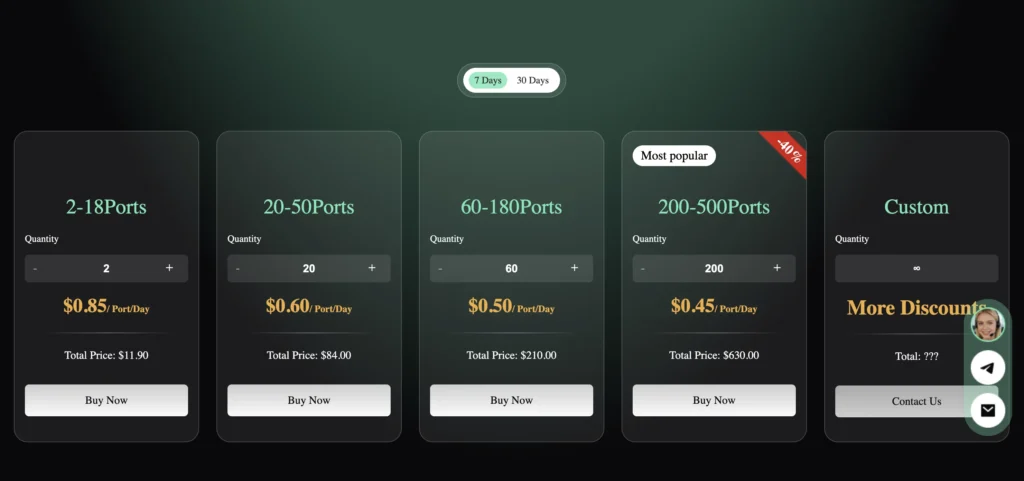
FluxISP static ISP proxies are billed per IP with unlimited bandwidth – traffic is never metered or capped during the rental period. The base price starts at $1.8 per IP. Bulk packages reduce the per-unit price proportionally. Every address is allocated exclusively: no shared pool, no shared reputation history.
For teams managing tens or hundreds of accounts simultaneously, package purchases consistently produce lower per-account costs than single-IP purchasing at the base rate. The static ISP residential proxy private unlimited bandwidth model also removes the cost unpredictability associated with traffic-billed residential proxies when session volume is high.
- Static ISP proxies: from $1.8/IP – fixed address, unlimited bandwidth
- Dynamic residential proxies: from $0.49/GB — rotating, unlimited IP pool
- Uptime SLA: 99.92% guaranteed
- Average response time: under 0.5 seconds across global nodes
- Protocols: HTTP and SOCKS5, both included at no extra cost
- Geo-targeting: country, city, and ASN provider filtering
- API: full REST API for programmatic IP management
- Support: 24/7 live chat and Telegram
- Payment: cryptocurrency and bank cards, no KYC for most methods
Getting Started with FluxISP Static ISP Proxies: 3-Step Setup
Step 1. Register and select your package
Go to the FluxISP platform and choose between dynamic residential traffic and static ISP residential proxies. Select your country, filter by ASN, and set the number of IPs. The full package price appears before checkout – no surprise fees. For static ISP proxy pricing
by tier, the Unlimited Static ISP pricing page shows the per-unit cost at each volume level.
Step 2. Retrieve the connection string
After payment, every IP appears in the dashboard with a ready-made login:password@host:port connection string. Select HTTP for browser-based tools and scraping libraries. Select SOCKS5 for Telegram, messaging apps, and any application using non-standard ports – SOCKS5 does not expose a proxy header to the target server and handles UDP traffic correctly.
Protocol selection: SOCKS5 is the default recommendation for account-based work. It does not reveal the proxy header to the target, handles UDP traffic (important for messaging and VoIP), and authenticates by login and password without additional configuration. HTTP/HTTPS integrates more easily with most scraping frameworks
and browser extensions.
Step 3. Connect to your tool
Paste the connection string directly into an antidetect browser – Multilogin, GoLogin, AdsPower, or Dolphin Anty – a scraping script, or Telegram Prime without additional configuration. FluxISP’s REST API allows programmatic management: retrieve your IP list, check status, and rotate credentials without logging into the dashboard. This makes FluxISP static ISP proxies suitable for automated pipelines that require IP management at scale.
Frequently Asked Questions About Static ISP Proxies
What does static ISP proxy mean?
A static ISP proxy is a fixed IP address registered with a real internet service provider, hosted on a server in a data centre. It combines ISP-level trust with server-grade speed and does not change between sessions. Anti-fraud systems score it as a residential connection, while operators benefit from the stability and speed of server infrastructure.
Are static ISP proxies the same as static residential proxies?
Yes. Static ISP proxies, static residential ISP proxies, and ISP static proxies are different names for the same product. The defining features are always the same: a fixed address, ISP registration in WHOIS, server hosting, and exclusive allocation to one user. The terminology differs between providers but the product does not.
Do FluxISP static ISP proxies include unlimited bandwidth?
Yes. FluxISP static ISP residential proxies are billed per IP address, not per gigabyte. Traffic is unlimited for the entire rental period. This makes monthly cost fully predictable regardless of session volume – a structural advantage over traffic-billed alternatives for intensive account work.
Which countries are available for static ISP residential proxies?
FluxISP covers 30+ countries. Commonly requested regions include Russia, Kazakhstan, Germany, the USA, and Mexico. ASN-level filtering lets you select the exact provider – Rostelecom, Comcast, Deutsche Telekom – from the dashboard without contacting support.
What is the difference between static and rotating residential proxies?
Rotating residential proxies change the IP address automatically at set intervals and charge per gigabyte of traffic. Static ISP residential proxies keep the same address for the full rental term and charge per IP with unlimited traffic. Rotating proxies suit large-scale scraping. Static ISP proxies suit account management, ad platforms, and any workflow where IP consistency matters.
FluxISP Static ISP Residential Proxies: When Consistency Is the Requirement
Static ISP proxies occupy the space where datacenter IPs fail anti-fraud checks and rotating residential proxies break sessions at the wrong moment. A fixed ISP-registered address with unlimited bandwidth, ASN-precise geo-targeting,
and 99.92% uptime removes the infrastructure variables that cause account restrictions, session drops, and unpredictable costs.
FluxISP delivers both static ISP residential proxies for account and automation work starting at $1.8 per IP, and dynamic residential traffic for high-volume scraping from $0.49 per gigabyte — from the same dashboard, the same support team, and the same billing account. Register on the FluxISP platform, select your region and ASN, and get a working connection string in under two minutes. No KYC for most payment methods. Technical support runs 24/7.